Login to your Lazo One account here
Login


Did you know a single hire or sale in another state can create a web of obligations that drains runway? For Delaware C-Corps, multi-state nexus is not theoretical, it drives real filing and payroll requirements across jurisdictions. We explain nexus in plain terms: economic thresholds, payroll, property, contractors, or remote team presence that trigger state obligations. Ignoring these rules invites penalties, audits, and unexpected cash demands.
Our approach blends cloud tools with human review to map your footprint. As a dedicated advisor and firm, we assess risk, register in required states, and manage filings so you avoid cleanup costs later. Schedule a free call if you are expanding or already crossed thresholds. We help founders protect runway, stay investor-ready, and keep focus on product while we handle state-by-state compliance and registrations.

Multi-state nexus determines where your Delaware company must file and pay state obligations. This legal link forms when you have sales, payroll, property, or a remote team in another state.
Once nexus exists, states can require registrations, returns, and payments, even if you’re incorporated in Delaware.
Failing to comply can lead to:
A single sale or remote hire can create a legal link that determines where your company must register, collect, and remit obligations.
Once nexus exists, companies must register in the state, open new tax accounts, and comply with recurring filings. Sales tax registration is often triggered first, while income or franchise filings typically follow as payroll or apportionment increases.
Here’s how it typically unfolds:
Thresholds change frequently. We monitor state nexus rules and align our services with your growth so compliance keeps pace with your expansion.
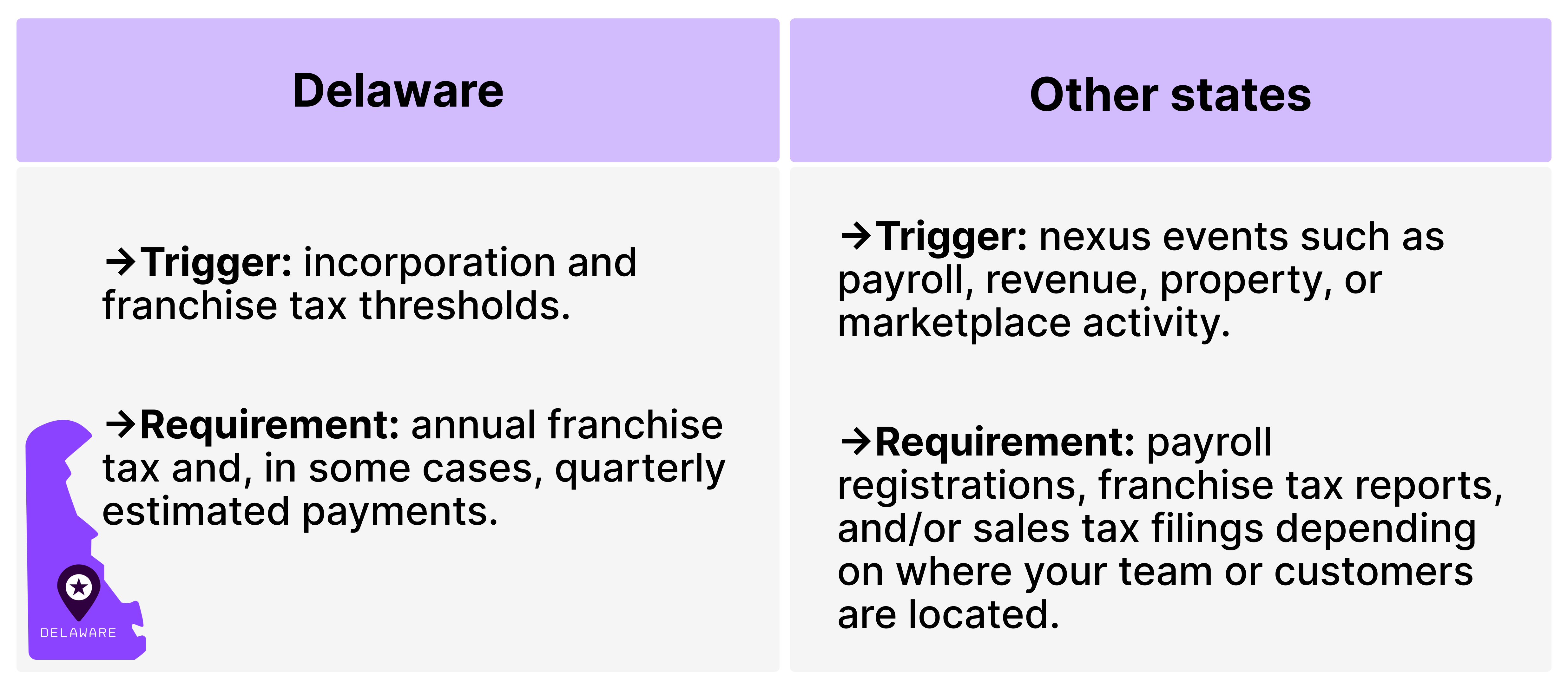
Being incorporated in Delaware does not stop other states from assessing obligations when you sell, hire, or maintain presence there.
Delaware offers governance and investor-friendly law, but it does not shield your business from local charges. Learn more about Incorporation and its tax implications.
New York quickly asserts payroll and local franchise rules once you have wages or sales there. For example, quarterly payroll filings via Form NYS-45 are common when you employ people in NY.
California, Texas, and Florida each have distinct thresholds and filing types. Sales, payroll, or a physical presence can trigger corporate income or franchise accounts and regular filings in those jurisdictions.
A Delaware charter helps with governance but doesn’t cancel tax obligations in other states. When nexus triggers are met, states assert jurisdiction regardless of where your company is incorporated. Founders often owe Delaware franchise tax while also filing payroll and income returns in other states. Coordinating these filings properly prevents missed deadlines and messy reconciliations.
Our services include exposure reviews, catch-up filings, and deadline tracking to remove compliance risk.
Reard more here: C-Corp vs LLC: What's the Right Structure for Your Startup.
Starting your U.S. company is a big step, especially if you’re based in Latin America. Once you incorporate, expanding operations (hiring, selling, or having a presence in other states) can create additional filing and tax obligations. We help founders understand what to expect as their company grows, from their initial Delaware incorporation to payroll and tax compliance across states. Streamline compliance and reporting with Lazo’s bookkeeping services, designed to keep your financials investor-ready from day one.
It all starts with a simple nexus risk review that maps your hiring plans, sales, and state presence so you know exactly which registrations and timelines apply to your business.
We build a predictable compliance rhythm so founders see obligations before they become surprises.Strengthen operations with Augmented Ops for payroll and sales workflows. We onboard week by week, delivering a state-by-state compliance plan and a shared deadline calendar your team can trust.
We gathered practical guides and tools so founders can act before filings become urgent.
Practical next step: if any resource shows exposure or upcoming filings, schedule a free call so we can turn guidance into a prioritized plan.
Missed registrations often turn into urgent liabilities that strain runway and distract leadership. States assess back taxes, interest, and penalties when filings are late. That creates cash pressure and can slow fundraising or deals.
Proactive multi-state management keeps runway intact and investor diligence clean. Multi-state nexus is an operational reality that affects payroll, sales, and filings like NYS-45 or Delaware franchise estimates. We combine accounting rigor and practical services to close exposure fast. Our team links QuickBooks or NetSuite with Gusto/Rippling and Avalara so reporting aligns with funding and investor timelines. From seed through growth, we deliver tax planning, tax preparation, and clean workpapers that reduce audit risk and ease diligence. We act as your advisor and partner to save time and protect capital.
👉 Schedule a free call today to map your footprint, prioritize next steps, and turn compliance into a strategic advantage.
Nexus is the connection between your company and a state that creates tax filing obligations. For Delaware C-Corps incorporated in Delaware but operating across states, nexus can be triggered by sales, payroll, property, or remote employees. Once nexus exists, you may owe sales tax, income or franchise tax, and payroll withholding in that state.
Common triggers include software or marketplace sales into a state, hiring remote employees or contractors, storing code or data on third-party servers, and having fulfillment or demonstration inventory. Fundraising and investor presence can also create touchpoints that lead to new filing obligations.
Yes. Incorporation in Delaware doesn’t eliminate tax obligations where you do business. You may face franchise or income tax where you have nexus, as well as payroll and sales tax in states where you hire or sell. Aligning Delaware status with operating states avoids duplicate filings and unexpected assessments.
Penalties vary by state but commonly include late-filing penalties, interest on unpaid taxes, and possible assessments for unfiled periods. Some states may impose back taxes for multiple years and require amended returns. Early remediation or voluntary disclosure programs often reduce penalties significantly.
We conduct a nexus risk review that maps revenue, customers, employees, contractors, inventory locations, and software infrastructure by state. We then compare those activities to current state thresholds and filing rules to create a prioritized registration timeline with a clear compliance plan.
Typical registrations include state sales tax permits, state income or franchise tax accounts, and payroll withholding accounts. Some states may also require apportionment filings or annual franchise returns. Correct registration ensures you operate legally and reduces audit exposure.
We implement a compliance engine combining monthly bookkeeping, quarterly estimated tax calculations, and timely year-end returns. This allows liabilities to be forecasted in advance, minimizing last-minute filings and penalties.
Yes. Qualified R&D credits can significantly lower federal and state tax liabilities. Properly documented credit claims can extend runway, reduce burn rate, and improve cash flow for growing companies.
We maintain IRS-ready bookkeeping, retain supporting documentation, and build an audit file with registration certificates, filings, and reconciliations. Our audit readiness includes internal reviews, remediation where needed, and full support during communications with tax authorities or investors.
We start with week-by-week onboarding that covers state mapping, registrations, bookkeeping cleanup, and tool integrations. From there, we execute a state-by-state compliance plan, deliver monthly accounting, and provide CFO-level tax planning. The approach scales from seed to Series B+ without needing a full-time finance hire.
We typically implement QuickBooks or NetSuite for accounting, Gusto or Rippling for payroll, and Avalara for sales tax automation. These tools integrate seamlessly to produce reliable reporting and automate remittances as the company scales.
Voluntary disclosure programs and remediation plans can help reduce or eliminate penalties. By filing proactively, you can minimize lookback periods, negotiate payment plans, and avoid more severe enforcement actions down the line.
You can book a free consultation with our team to get a tailored nexus assessment and registration plan. We’ll review your operating footprint, funding stage, and growth plans to prioritize filings and minimize cash-flow surprises.