Are startups tax-free for the first 3 years? Here’s what founders should Know
Startups don’t get a 3-year tax exemption, but they can access targeted benefits, R&D credits, and smart tax strategies to preserve runway and stay compliant.
There is no automatic three-year tax exemption for startups. However, depending on your business activities, structure and location, there are targeted credits and tax-benefit programs that may reduce tax burdens in early years.
Let’s address this question directly: according to theIRS, there isn’t a general 3-year tax exemption for startups. However, this doesn’t mean new businesses are left without support. Various tax benefits and credits are available to help alleviate the financial burden on startups.
Understanding these benefits is crucial for making informed decisions about your business’s financial health. While the promise of a straightforward tax exemption might be appealing, the reality is that numerous incentives can provide significant relief.
The common search: Tax-free years for new businesses
We hear this question a lot: are startups tax-free for the first three years? That belief usually comes from mixing up specific incentives with a universal rule. In reality, some programs offer limited relief, but there’s no broad multi-year exemption that covers all startups.
Why founders ask about the 3-year tax exemption
The idea is attractive because founders want to lower early operating costs. Common reasons this myth spreads include:
- Founders seeking ways to preserve runway and simplify early-stage finances.
- Mistaking state-specific or targeted federal incentives for a general exemption.
While a blanket exemption doesn’t exist, there are real, targeted tax benefits, like R&D credits and other incentives, that founders should evaluate for their specific business (see our guide to claiming R&D tax credits as a tech startup).
Origins of the tax exemption myth
The myth often springs from a few sources:
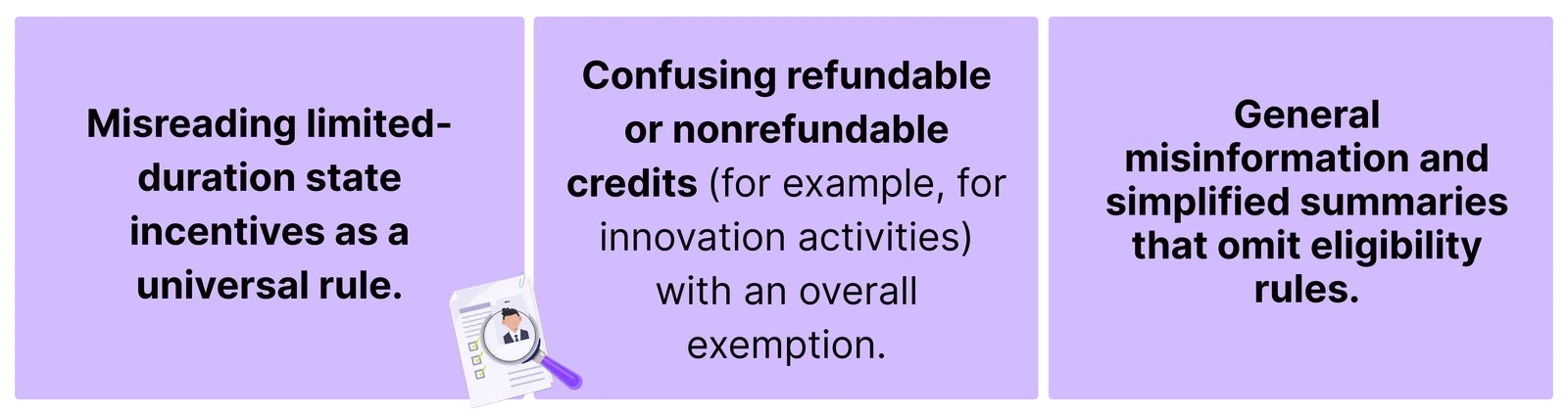
Understanding these origins helps founders separate useful opportunities from wishful thinking and focus on the benefits they can realistically claim.
The reality of the 3-year tax exemption for startups
- There’s no automatic 3-year tax-free period for startups.
- You face federal and state obligations from day one.
- Incentive programs may reduce costs but don’t replace tax compliance.
- Federal: EIN, annual reporting, payroll/self-employment taxes.
- State: franchise, corporate, sales/use, payroll, and filing fees vary by location.
- Your entity type determines how taxes are reported and paid.
- If your team is remote or distributed, check nexus rules (see our state income tax guide for remote-first startups).
- Understanding your structure is key to managing obligations effectively.
Real tax advantages available to startups
Even though a blanket tax holiday isn’t a thing, startups can access targeted incentives that support innovation and growth. These provisions won’t erase all obligations, but they can meaningfully lower liability when you meet the rules.
R&D Tax credits for innovation activities
The Research and Development (R&D) tax credit is one of the most useful incentives for innovation-driven startups. If your company undertakes qualified activities, like developing new software features or testing biotech prototypes, R&D credits may apply and reduce tax liability when claimed correctly (see our deeper guidance in the R&D credit guide).
Example: a software startup building a new platform or a lab refining a prototype may be able to capture R&D credits for eligible project costs. Qualification depends on IRS tests and documentation, so plan record-keeping around eligible projects.
Entity structure choices and tax implications
Your entity selection meaningfully shapes tax outcomes. Common structures include sole proprietorships, partnerships, LLCs, and corporations; each flows through tax differently and carries tradeoffs regarding investor friendliness and tax treatment.
- Pass-through entities let business income flow to owners’ personal returns, avoiding entity-level taxation.
- C-corporations are taxed at the entity level, which can result in different tax treatment for profits and distributions but often suits venture-backed startups.
Choose an entity with both tax and fundraising goals in mind; what’s optimal for day-to-day taxes may not be optimal for capital raises.
Incorporation considerations and jurisdictional benefits
Where you incorporate and where you operate are separate decisions. Some jurisdictions are preferred for corporate law and investor familiarity, while others are preferable for state tax posture. Delaware, for example, is commonly chosen for its corporate law framework, but that doesn’t automatically mean lower state taxes for operations.
Consider both incorporation law and the state-level tax consequences where you will hire employees, sign contracts, and generate revenue.
Net operating loss provisions
Startups commonly run losses early on. Tax rules allow those losses to be used against future taxable income, subject to statutory limitations and timing rules. That carryforward treatment can smooth tax liability as you scale and become profitable.
Net operating loss provisions are a planning tool, track losses carefully and discuss with your tax advisor how best to use them within your long-term growth plan.
Note: The QSBS (Qualified Small Business Stock) exclusion under IRC §1202 is not a startup tax waiver for operational expenses; it’s a capital gains benefit that applies when qualifying shares are sold after the required holding period**.** Learn more in Tax benefits of Qualified Small Business Stock (QSBS).
Eligibility requirements and compliance risks
Knowing who qualifies for tax benefits, and where the traps are, is essential for founders. Eligibility depends on technical rules, and small missteps in classification or record-keeping can cost you credits or trigger penalties.
Qualification criteria for tax benefits
To qualify for tax benefits, startups must meet specific criteria set by the IRS. For instance, QSBS (Qualified Small Business Stock) offers significant tax advantages, but eligibility depends on factors such as the company’s business activities and asset allocation.
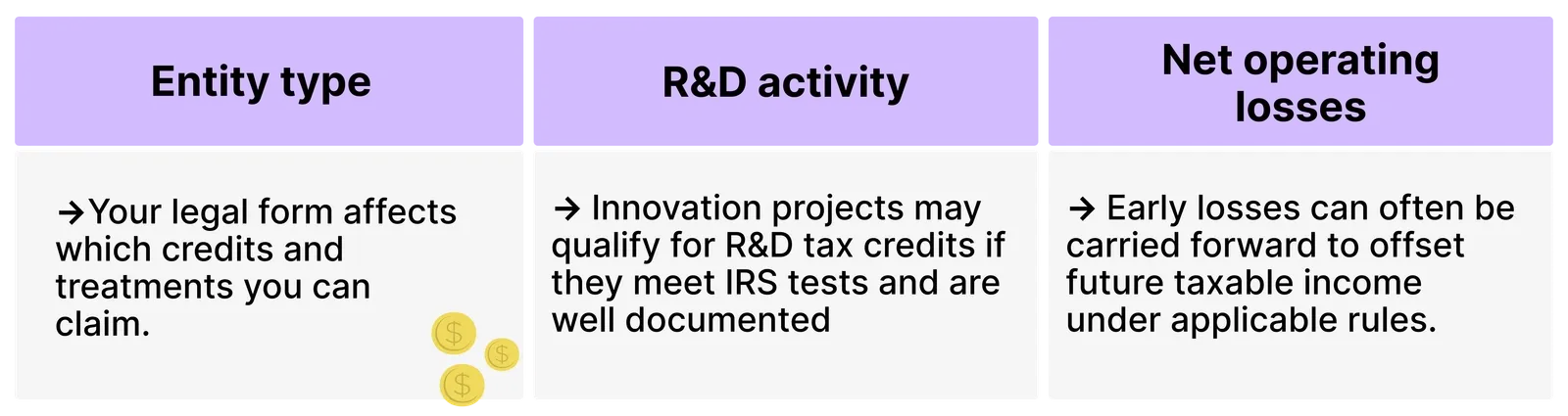
Another valuable option for some founders is QSBS. The rules address factors like the company’s business activities, gross asset tests, and when shares were acquired — these are technical and should be reviewed with counsel.
Common compliance pitfalls for new companies
- Misclassification: Treating workers as contractors instead of employees (or vice versa) can cause payroll and withholding issues.
- Poor documentation: Weak record-keeping makes it hard to support R&D claims or other credits during review.
- State obligations: Missing registration or filings in states where you have nexus can create unexpected exposure.
Penalties for tax misunderstandings
Authorities can assess penalties and interest for missed filings or incorrect positions. The simplest mitigation is careful setup and timely filings plus professional advice when rules are ambiguous.
Practical tax planning steps for founders
Good tax planning preserves runway and reduces surprises. Treating taxes as part of your strategy, not an afterthought, helps keep cash flow predictable and compliance on track.
- Choose the right entity: Pick a structure that fits your fundraising, ownership goals, and tax strategy. Get legal and tax advice early.
- Set up clean bookkeeping: Reliable systems help track revenue, expenses, payroll, and R&D costs.
- Work with tax professionals: Bring advisors in during key moments, fundraising, equity grants, international hiring, or M&A.
- Use a compliance calendar: Stay ahead of filing and payment deadlines.
These steps provide a solid foundation, but always work with a tax advisor to tailor your plan to your company’s goals.
How Lazo supports startup tax compliance
Lazo helps founders stay on top of tax obligations so they can focus on building product and growing their companies. We combine hands-on bookkeeping, tax planning, and fundraising guidance designed specifically for startups and small businesses.
Bookkeeping services for tax readiness
Accurate bookkeeping is the foundation of strong tax compliance. We keep your financial records organized and up to date, which:
- Simplifies tax filing.
- Provides clear visibility into your financial health.
- Reduces the risk of costly errors during tax season.
Our team handles the complexities of startup finances so your books stay clean and compliant. Learn more about our bookkeeping services.
Tax filing and planning support
We help founders plan and file with confidence by offering:
- Tax planning tailored to your business model.
- Identification and documentation of credits and deductions (like R&D).
- Compliance support for federal and state obligations.
Fundraising considerations and tax implications
Equity, convertibles, and debt can create complex tax implications. We help you align your fundraising strategy with your tax strategy so you can grow with clarity and confidence.
From Lazo’s experience
At Lazo, we’ve helped hundreds of founders structure their companies for long-term success, from incorporation to fundraising prep.
We’ve seen too many promising startups break apart because they skipped this step.
Our team of legal and financial experts help founders design vesting agreements that make sense for their business model, stage, and investor expectations.
What founders should do next
- Review your current equity structure. Are all founders properly vested?
- If not, make it a priority to set up your FVA before fundraising.
- Get expert support. A well-drafted vesting agreement protects you now and increases your valuation later.
Ready to protect your startup and build investor trust? Talk to us and set up your Founders Vesting Agreement today.
Conclusion: Building a tax-smart foundation
Understanding and using targeted tax benefits is more useful than hoping for a blanket tax holiday. Combine compliant bookkeeping, proactive planning, and the right entity/incorporation choices to preserve runway and scale.
Practical next steps: maintain accurate records, engage a tax advisor when needed, and track deadlines on a compliance calendar.
Ready to replace guesswork with a plan that works?
FAQ
Do startups really get a 3-year tax exemption?
No, there is no general 3-year tax exemption. Startups can access targeted benefits like R&D credits and NOLs if they meet eligibility rules.
What are the federal tax requirements for new businesses?
Requirements depend on your entity and activities; at minimum, businesses must register, report income/expenses, and handle payroll-related taxes where applicable.
How do state-level tax obligations affect startups?
States tax from day one; review your footprint and see our remote-first state tax guide for common scenarios.
What are R&D tax credits, and how can startups benefit?
R&D credits may reduce liability for qualifying innovation projects; eligibility hinges on documented activities and expenses (see theR&D guide).
How does the entity structure choice impact tax implications?
Entity choice determines who pays tax and how income is reported; align the decision with fundraising and ownership plans.
What are the common compliance pitfalls for new companies?
Misclassification, weak documentation for credits, and missing state registrations, fix with disciplined books and early counsel.
What are the penalties for tax misunderstandings or non-compliance?
Authorities may assess penalties/interest for late or incorrect filings; timely filings and professional advice reduce risk.
How can startups ensure tax compliance?
Maintain accurate records, pick the right entity, use a compliance calendar, and consult tax professionals to confirm eligibility for specialized benefits.
What bookkeeping practices support tax readiness?
Record promptly, keep project-level documentation, reconcile regularly, and use cloud accounting to stay audit-ready.
How can Lazo support startups with tax compliance?
Lazo provides bookkeeping, filing/planning support, and fundraising tax guidance.