How to prepare for U.S. tax season 2026 as a foreign founder
A practical guide for foreign founders preparing for U.S. tax season 2026. Learn filing requirements, key deadlines, common mistakes, and how to stay compliant with clarity.
U.S. tax season has a way of sneaking up on foreign founders.
You incorporated months ago. You opened a U.S. bank account. Maybe you raised capital or hired your first contractor. Everything felt under control until the question appears:
“Do I actually need to file in the U.S. this year?”
Short answer: very likely, yes.
Preparing early for U.S. tax season 2026 is not about paying more taxes. It is about avoiding penalties, protecting your company, and showing investors that your operations are solid and credible.
This guide breaks it down clearly, without legal jargon.
What you’ll get from this post
📌 Who needs to file U.S. taxes in 2026 as a foreign founder
📌 The key forms non-U.S. founders usually miss
📌 Critical deadlines you should prepare for now
📌 Common mistakes that create penalties or red flags
📌 How Lazo helps founders stay compliant without friction
Do foreign founders really need to file U.S. taxes?
Yes, in most cases.
If you incorporated a U.S. entity, especially a C-Corp or LLC, the IRS expects filings even if:
• You had no revenue
• You did not pay yourself
• You are not living in the U.S.
• The company is inactive
The IRS cares about structure, ownership, and activity, not just profits.
Typical scenarios that trigger filing obligations:
• You incorporated a U.S. company and got an EIN number
• Your company has foreign owners
• You have a U.S. bank account
• You issued shares or SAFEs
• You paid contractors or employees
• You dissolved the company in 2025
No activity does not mean no filing.
Which tax forms should foreign founders expect in 2026?
This depends on your entity type and ownership, but these are the most common.
C-Corp with foreign shareholders
• Form 1120: U.S. corporate tax return
• Form 5472: disclosure of foreign ownership and transactions
• State returns if you have nexus
Even with zero revenue, Form 5472 is mandatory, and penalties for failing to file can be up to $25,000 per year.
LLC owned by a single foreign founder (Disregarded Entity)
• Pro forma Form 1120
• Form 5472
• Additional owner-level filings may apply if the LLC has ECI
LLC with foreign multiple members (Partnership)
• Form 1065
• Schedule K-1 for each member
• Withholding filings may apply if income is allocable to foreign members
• Additional owner-level filings may apply for foreign members if the LLC generates ECI
What are the key deadlines for U.S. tax season 2026?
For companies operating in 2025, filing season happens in 2026.
Core deadlines to prepare for:
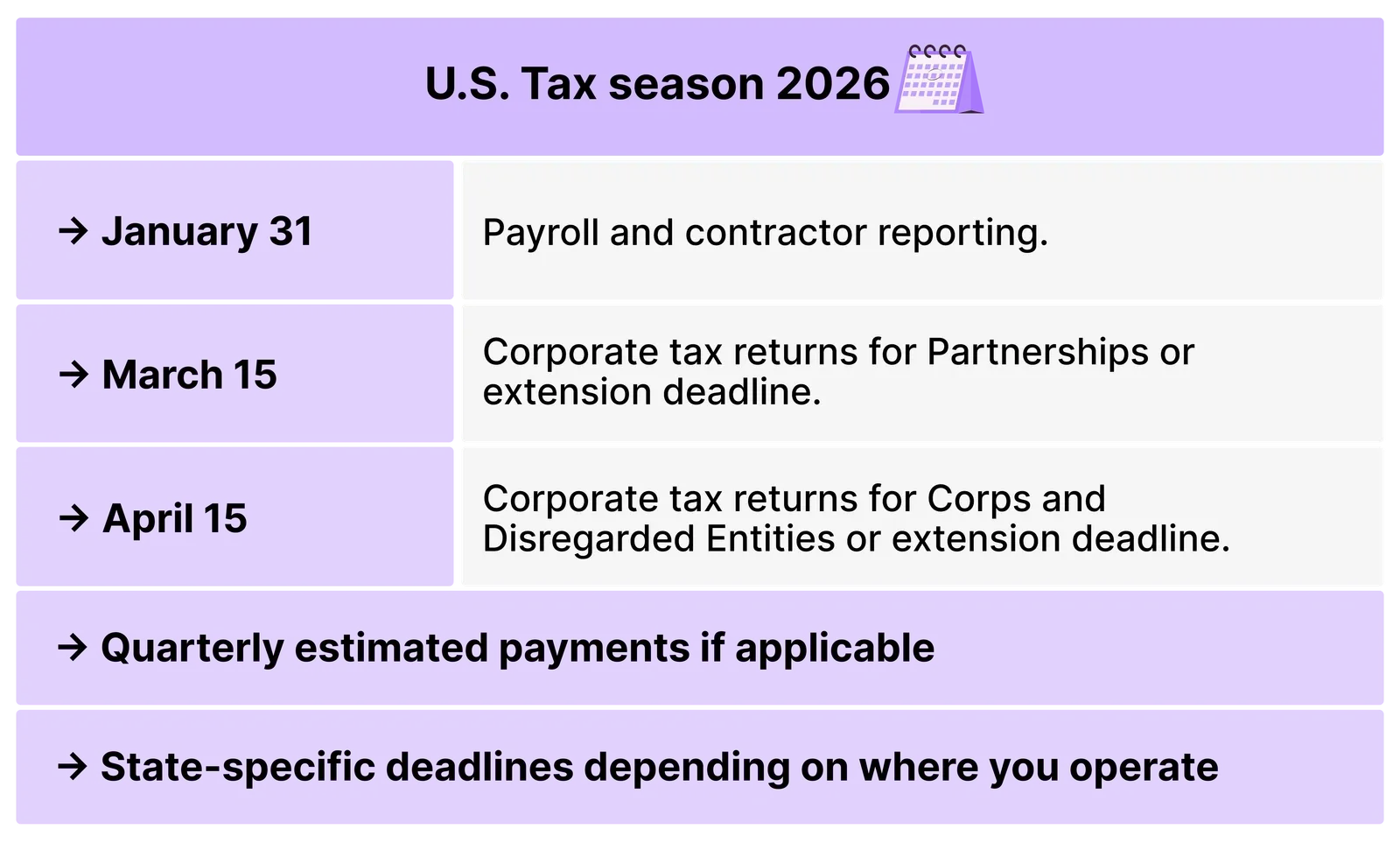
Extensions give you time to file, not time to pay. Planning cash flow matters.
What documents should you start organizing now?
Strong tax preparation starts with clean documentation.
Foreign founders should prepare:
• Certificate of incorporation and EIN Letter (CP575)
• Cap table and ownership records
• Accounting method (cash vs accrual)
• Any tax elections filed (e.g. Form 8832)
• Bank statements for the full year
• Expense records and invoices
• State registrations and filings (if applicable)
• SAFE or note agreements
• Payroll and contractor payments
• Proof of company address and registered agent
• Dissolution documents (if applicable)
If you raised capital, issued equity, or changed structure, those events must be reflected correctly.
What are the most common mistakes foreign founders make?
At Lazo, we see the same issues every year.
• Assuming no revenue means no filing
• Missing Form 5472 and triggering automatic penalties
• Not having a reliable U.S. address to receive and track IRS and state correspondence
• Ignoring state filings after hiring remotely
• Mixing personal and company expenses
• Waiting until March to organize documents
• Filing without understanding foreign ownership rules
Most penalties are avoidable with early preparation.
How does U.S. tax compliance affect fundraising?
Investors care deeply about compliance.
During due diligence, they will ask for:
• Filed tax returns
• Clean cap tables
• Proof of good standing
• No outstanding IRS notices
Late or missing filings slow down rounds, increase legal costs, and create trust issues.
Clean taxes signal operational maturity.
From Lazo’s experience
At Lazo, we work with foreign founders across Latin America, Europe, and beyond who operate U.S. companies.
The founders who have the smoothest tax seasons do three things:
• Prepare early
• Keep clean books
• Ask questions before filing deadlines
Our team supports founders with:
• U.S. tax filings and extensions
• Foreign-owned entity compliance
• Bookkeeping aligned with IRS expectations
• Registered agent and address services
• Company dissolutions
• Fractional CFO and Controller support when needed
We translate U.S. tax complexity into clear, actionable steps.
What founders should do next
If you are a foreign founder with a U.S. company, now is the moment to prepare.
Practical next steps:
• Confirm your entity type and ownership structure
• Identify required federal and state filings
• Organize 2025 financial records
• Review foreign ownership disclosures
• Set a tax calendar for 2026
👉 Talk to Lazoand get your U.S. tax season handled with clarity.
You did not build your startup to worry about forms and penalties. We help you stay compliant so you can stay focused on growth.