The Cayman Sandwich, explained: structure, compliance and taxes
What investors, founders and Lazo experts shared at our webinar with Caravela Capital and Kamino.
Why everyone is talking about the Cayman Sandwich
If you’re a LatAm founder about to raise from global VCs, someone will ask you about a Cayman Sandwich. At Caravela Capital, an early-stage VC based in Brazil, 27 of 30 active portfolio companies run on it.
In October we hosted a #LazoTalks webinar with Caravela Capital and Kamino to unpack it: why funds ask for it, what a founder lives with once it’s built, and what it takes to keep it compliant. Here’s what we learned.
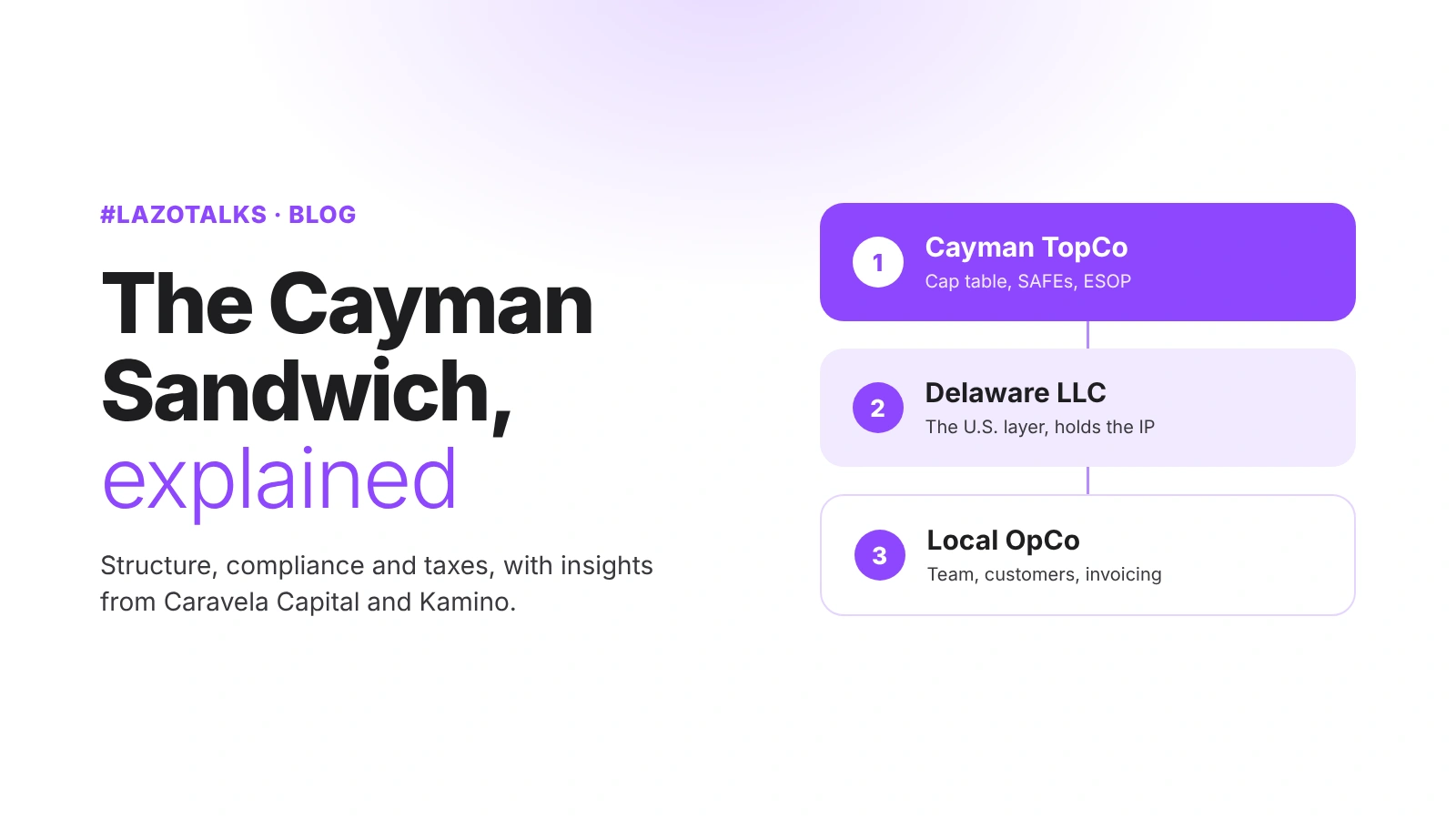
What a Cayman Sandwich is
A Cayman Sandwich is a three-layer structure across three jurisdictions. The easiest way to remember it: capital comes in at the top and flows down to where it’s needed.
At exit, a buyer can come in at any level. That’s where taxes come into play.
How investors see it
For Caravela Capital, the structure is the starting point. “For us, the sandwich is basically a default,” said Victor Roriz. Caravela invests from pre-seed to Series A across Latin America, alongside U.S. and international funds.
He gave two reasons:
- It’s the market standard. “That is where we are comfortable investing.”
- They co-invest with global funds. “Which is why structure matters so much to us.”
In due diligence, two things slow a round down:
- The cap table. Notes that were never written down, or ex-partners who still hold equity, stop the flip until everyone signs.
- The intellectual property. Code and trademarks must be owned by the company, not by a contractor or a founder.
The difference shows in the timeline. “A clean company flips in about 60 days. A company with a messy cap table can take four months.”
A founder’s view
Kamino set up its Cayman Sandwich from day one, before its pre-seed, because it had U.S. lead investors. “The foreign funds are already familiar with the Cayman Delaware structures. So no one had to learn something new to invest in Kamino,” said Juliana Strohl, Kamino’s co-founder.
The goal was to raise many times without bringing investment directly into Brazil, where SAFEs and preferred share classes are harder to use. Her worries going in were practical:
- Running three companies in three countries before having revenue.
- Setup fees and advisors in every layer.
- Money getting stuck between layers, and explaining the structure to the Brazilian regulator.
It worked. Due diligence went smoothly and money moved between accounts without issues. Her main advice is about what comes after: “The setup is the easy part. The maintenance is the tough one.” Treat it as a subscription, not a one-time fee, keep the register of members matched to the cap table, and choose your initial U.S. tax election carefully, because it follows you.
When Cayman makes sense, and when it can wait
Cayman is an answer to a goal, not a default. It fits when you’re raising from international funds and have an exit on the horizon. Its advantages are tax neutrality (no corporate tax, no capital gains tax, no withholding on dividends), standard documents like YC SAFEs and option pools, and an exit where a buyer can acquire the whole group or a single operating company.
It’s not all or nothing. Many startups start with a Delaware LLC owning the local company, then add the Cayman holding on top at their first priced round. The LLC doesn’t go to waste: it becomes the middle layer. If most of your market, buyers and investors are in the U.S., a Delaware C-Corp is usually the natural choice.
Keeping the Cayman layer compliant
The standard vehicle is the Exempted Company. It has its own legal personality, shareholder liability is capped at what they subscribed, it can be 100% foreign-owned, it allows tailored share classes and board-granted options with vesting, and it has no minimum capital. It pays zero corporate tax, zero capital gains tax and zero withholding.
Zero taxes doesn’t mean zero obligations. For a pure holding, there are six ongoing ones:
- KYC on directors, shareholders and beneficial owners, repeated for every new investor.
- Registered agent and registered office in the Cayman Islands, through a regulated provider.
- Annual government fee, based on authorized capital.
- Economic Substance Notification, due by January 31 every year, for every entity without exception.
- Beneficial ownership register for anyone holding more than 25%, with fines of up to US$30,000.
- Up-to-date corporate registers, reporting every change in members, shareholders or directors.
Economic substance, made simple. A pure holding (it only owns shares and earns dividends and capital gains) follows a reduced test: no local employees, office or board meetings. It files the notification by January 31 and an Economic Substance Return within 12 months of fiscal year-end. In practice, the registered office usually satisfies the reduced test. If the holding starts providing services to group companies or earning IP income, the full test applies. That’s why the real business lives below it.
The U.S. side: forms, ECI and exit taxes
Cayman is zero tax, but the structure touches the U.S. Three questions decide what you file with the IRS: how the Cayman company is classified, whether there is effectively connected income (ECI), and whether there are U.S. partners.
Classification. By default, an Exempted Company is a foreign corporation for U.S. tax purposes. It can elect to be a partnership or disregarded entity with Form 8832, and that choice generally can’t be changed for 60 months. For a holding with non-U.S. founders, the default usually works.
The Delaware LLC. As a foreign-owned disregarded entity, it files a pro forma Form 1120 and Form 5472, reporting transactions with its foreign owner (capital contributions, loans, dividends, fees). It pays no U.S. tax as long as there is no ECI. Form 5472 is due April 15 (October 15 with extension), and missing it costs US$25,000 per form, per year, even with no tax due.
ECI. Income from an active U.S. trade or business. A pure holding with no U.S. employees, offices or agents generally has none. Founders or staff working from the U.S. can create it, and Cayman has no tax treaty to protect it.
At exit, what you sell decides the tax (U.S. federal tax only; your home country taxes apply separately):
What the Cayman company itself files depends on its classification and on ECI:
Questions from the live Q&A
I have a Delaware LLC. Should I set up the Cayman holding now or wait until I raise? It depends on your next round. For a small pre-seed with angels, there’s no rush. If you’re planning a meaningful seed round with global funds, start considering it now. Where the founders live, where customers are and who you’re raising from all shape the answer. An existing LLC doesn’t go to waste: it becomes the middle layer.
How long does it take to set up a Cayman entity? Around 10 business days. The registered agent’s KYC review takes 5 to 10 business days, then incorporation takes about 5 more. The main factor is how quickly you provide the KYC information.
When does a pure holding need local offices or employees? Only when it stops being a pure holding. As long as it only owns shares and receives dividends and gains, the annual notification is enough. Hiring people or running operations from the Cayman entity triggers the full economic substance requirements.
Can I reuse an old Cayman company for a new project? Often yes, but it depends on how the company was used before. It needs a review first.
What about Wyoming for web3 startups? We’re seeing more questions about it. For traditional venture capital, Delaware remains the standard. Web3 investors have more varied views on jurisdiction.
This content is for information only and isn’t tax or legal advice. U.S. federal tax only; taxes in your home country apply separately.
About Lazo. AI-powered incorporation, taxes, bookkeeping, fractional CFO and fundraising for startups. Trusted by 1,500+ startups. Backed by AlleyCorp, AWS & Google for Startups.